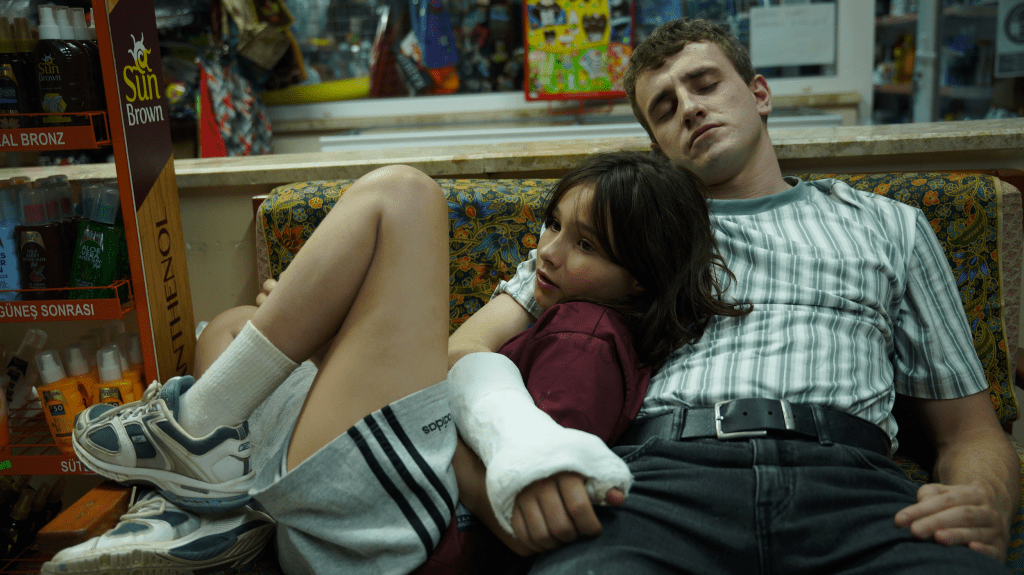
Aftersun is Charlotte Wells’ directorial debut staring Normal People’s Paul Mescal as Callum, and eleven-year-old newcomer, Frankie Corio, as Sophie. Callum is Sophie’s father; the pair are on an all-inclusive trip to Turkey and Callum is just about to celebrate his 31st birthday.
All is well! Maybe… kind of… not really? Wells’ is unrevealing. She places her audience on the edge of a cliff for the entirety of the film. The feeling you have when you’re stood on a bridge, the way your stomach knots as you look down to see the drop, the empty space … that is Callum. Callum is a bruised man, seemingly full of secrets and regret. Everything he does feels dangerous but, Wells makes sure to never tell us why… that’s for us to decide. Put that in an all-inclusive, ‘Brits Abroad’, holiday resort (kind of shit but fun, nonetheless), an environment that exudes nothing but fondness and comfort. As an audience, we are dumped at an emotional crossroads. We are torn between feelings of nostalgia and sentiment as we watch Sophie’s coming-of-age: the sweetness of her first kiss, the innocence of her infatuation with the ‘big kids’. But still, there is something deeply concerning about Callum and we are constantly reminded of this. We’re still on that cliff.

I saw this film a few weeks ago. But, I must admit this review has sat in my drafts for quite some time now. I know I was affected by this film, it lingered with me and I haven’t had a cinematic experience like that for a while. However, I can’t quite put my finger on why. Living with a member of the cast (Kayleigh Coleman in the role of Jane), has helped me I must admit. Our hours of conversation, discussing her time on set, the stories she’s told me of Charlotte Wells as a director, and her experiences working alongside Paul Mescal and Frankie Corio has definitely deepened my insight. But still, Aftersun is an emotional mystery. Words don’t to do justice to the remarkable examination of the human psyche Charlotte Wells presents to us.
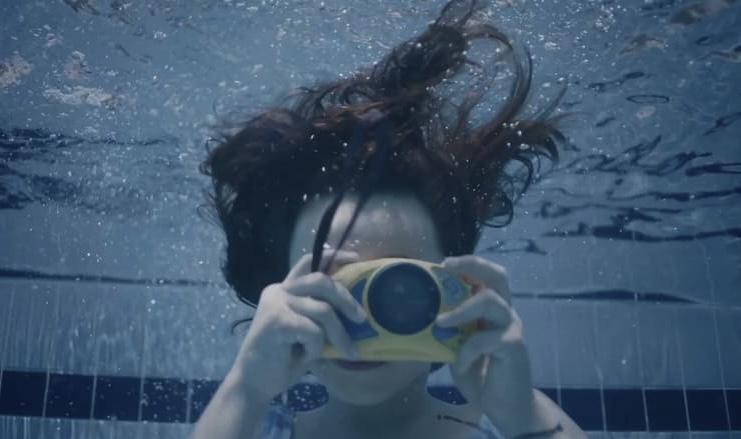
A particular motif that stood out to me was the constant use videotaping and photography. Obviously Aftersun is set in the 90’s, so the nostalgic tone is only enhanced by the gorgeous shots of home-video tape, which Sophie records of the trip, as well as the constant taking of polaroid photographs (which the camera makes sure to linger on as they develop). It is only later in the film, do we see a grown-up Sophie, alone, watching these tapes back. The reason why is never revealed… however, I don’t believe it would be wrong to assume that this trip was the last she ever went on with her father. She seems to be using these tapes as a way of reliving her final memories with him.
Cinematographer Gregory Oke lights adult Sophie with cool, abrasive blue tones. Her face is stunned with the harsh white light of the TV screen revealing her tired expression, it seems that years of maturity have wounded her the same way they did her father. This contradicts the warmth we see in Turkey years prior. A particular stand-out shot is of Sophie and Callum dancing at the resort, orange lights their faces as Bowie and Queen’s “Under Pressure” plays. We cut back and forth from their warm embrace to snap shots of adult Sophie, looking confused and lost in a nightclub. The lyric “This is our last dance” suddenly takes on a whole new meaning as past meets present in the most haunting way.
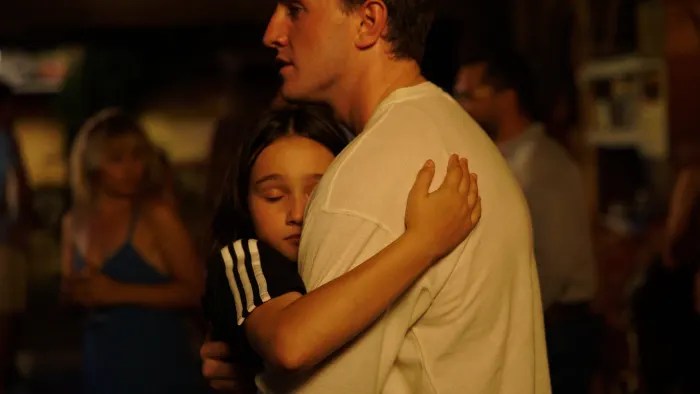
The examination of Memory in Aftersun is the heart and soul of the film. Memories are weird because, like emotions, they are not tangible. They are not physical; you can’t touch them. They’re not real… yet, they’re also the most real thing we know. I think this is the paradox that Wells’ is trying to reveal in Aftersun. That is what a photograph is, essentially. It’s a memory, it’s proof of a life what once was and of an experience. Photography takes us from the now and the here, to the then and the there. It’s the paradox of memory.
Watching adult Sophie reflect on her childhood videotape is the emotional punch of the film. We see her long for a life that was. She now sees her father through experienced eyes, her childhood innocence gone, and she is no longer protected from his pain and secrets. As a child, Sophie longs to be older than she is (as we all probably did) she’s embarrassed by her youth and wants to be just as cool and old as the group of teenagers she meets at the resort. Callum, on the other hand, wonders where the years have gone. “When you were eleven, what did you think you’d be doing now?” Is the question Sophie asks her father which seems to strike quite a chord inside of him. He doesn’t answer… but I’m sure his answer would not be, fathering to an 11-year-old at just the age of thirty.
Later that night, we see Callum cry alone in his room. The camera stalks his back for just too long and the sound of his sobbing echoes. We intrude on his vulnerability; it feels like we shouldn’t be seeing this. Both Callum and Sophie are equally as vulnerable, just in completely opposing ways. Their relationship is delicate, familiar and loving but their years apart mean they are constantly exploring each other’s personal worlds with softness, and a want to understand. It is this curiosity that makes Aftersun heartbreakingly relatable for us all.
Lucy Speer
8th of January 2023
 There Will be Spoilers