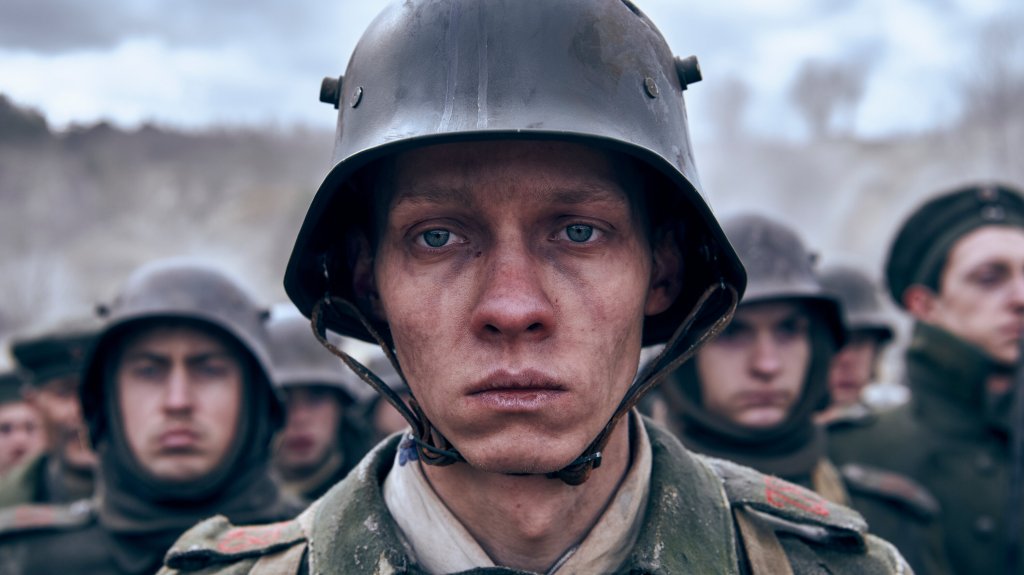
Edward Berger’s All Quiet on the Western Front (2022) is the first German remake of Erich Maria Remarque’s 1929 novel, “Im Westen nichts Neues” (“Nothing New in the West”). Remarque’s novel was radical at its time of publication. It became one of the first internationally best-selling novels and was subsequently translated into more than 50 languages. It became known as “the best and the worst war novel”: praised by pacifists for its humanist values and strong anti-war statement and criticized by Nazi Germany for these exact reasons.
With such influence and revolution, its unsurprising Edward Berger’s 2022 picture is the third time the novel has been told on the big screen. Lewis Milestone’s “All Quiet on the Western Front” (1930) infamously took home the Academy Award for Outstanding Production (now known as the Best Picture category) and sparked wide controversy amongst Hitler’s Nazi party. On the 4th of December 1930, at its German premiere in Berlin, Nazi parties bombed the screenings with stink bombs opposing its “anti-German propaganda” and pacifist message.
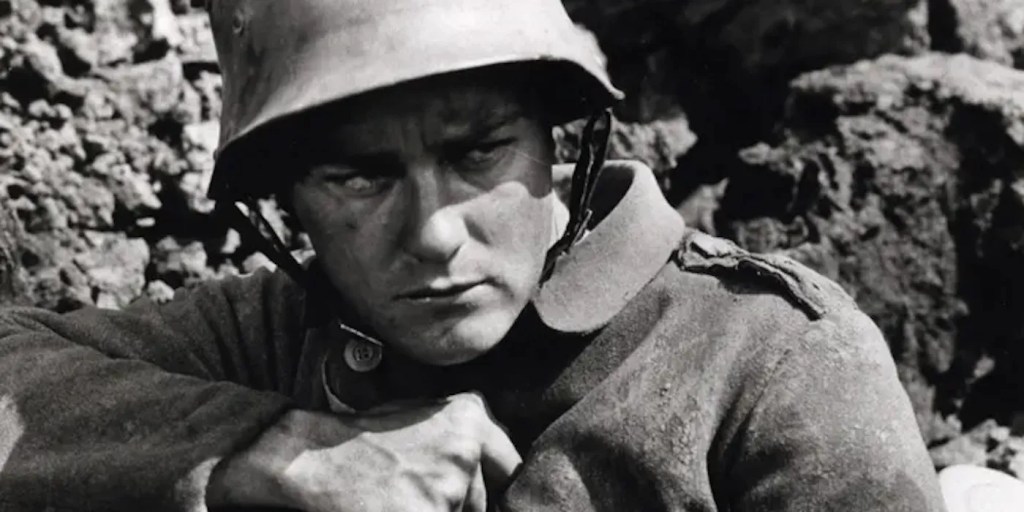
With such a history, the 1929 tale of “All Quiet on the Western Front” is undeniably anti-war and bleak in its depiction of futile, senseless violence. Berger succeeds in capturing exactly this in his 2022 remake. This is the first time the novel has been remade in its native language, German, and it’s Berger’s factualism that makes the picture even more barbarous and horrifying to watch.
Any anti-war film has a moral obligation to portray violence and warfare as completely senseless and horrifying. There cannot be a happy ending. There cannot be a hero or a redemption arch- this would suggest that there is some kind of productivity to battle, or worthwhileness. The idea of War being a purposeless killing spree is what Berger depicts in All Quiet on the Western Front, and what other Hollywood War films have missed. Of course, there are great tales of heroism in war and, in no way am I saying that these tales are not worth telling… they are! However, when considering the Hiroshima of lives lost in the First World War, to be truly anti-war its vital that any satisfaction the audience could feel to oppose the bloodshed, needs to be ejected. We need to feel empty when the ending credits roll.
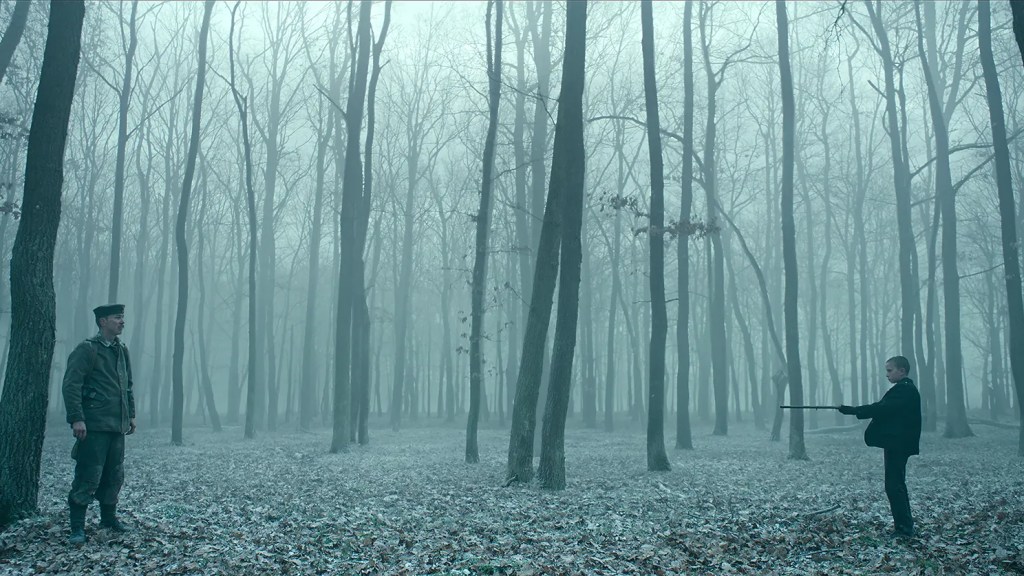
Tim O’Brien said, “If a story seems moral, do not believe it. If at the end of a war story you feel uplifted, or if you feel that some small bit of rectitude has been salvaged from the larger waste, then you have been made the victim of a very old and terrible lie.” This is the exact sense of despondency All Quiet on the Western Front captures and why it is such a grim watch. Unlike Sam Mendes’ “1917”, which is arguably the most well-known cinematic World War I tale, the protagonist does not succeed on his mission. Quite the opposite actually… for two hours and thirty minutes we follow Paul Bäumer (excellently played by Felix Kammerer): a naïve, patriotic teenager sold a dream of heroism and valour if he serves his country during battle. He enlists himself into the German Army only to have, what he thought, would be an exciting expedition to Paris, turn into a treacherous odyssey for survival. Paul endures. He’s fighting a losing battle, his sole objective being to make it home alive. As an audience, we endure with him. There is nothing rewarding in watching All Quiet on the Western Front, Berger does not sugar-coat. The shots are simply horrifying: mangled bodies, stray limbs, massacred troops. But that’s the point: it’s an anti-war film.
Retrospect is essential for this film. It’s a tale told from the losing side, that only the losing side could tell. All this bloodshed… for what? We know that the Germans lost the War, and this perspective only makes it more difficult to watch Paul as he fights with hopelessness and despondency.
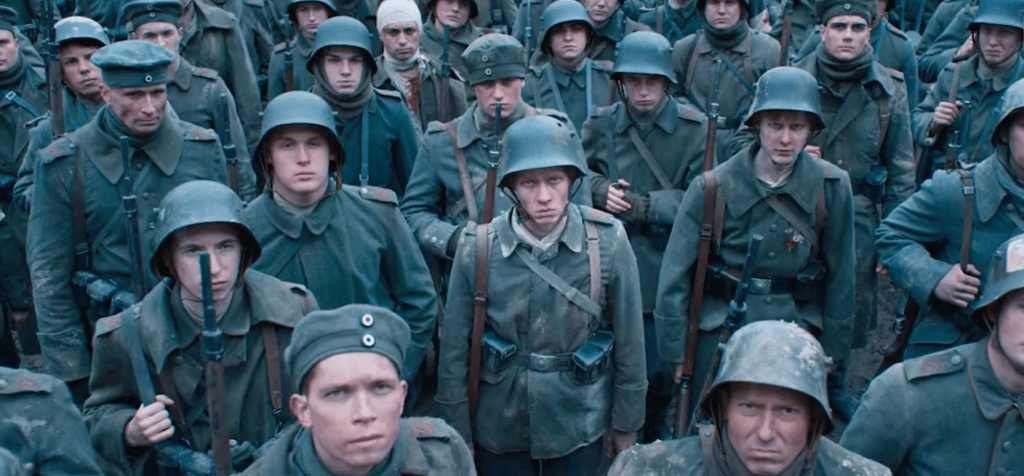
Despite remaining fairly loyal to the original novel, Berger introduces his own sub-plot: the negotiations that led to the signing of the Armistice agreement on the 11th of November 1918. The signing of the Armistice was a long, drawn-out process and despite being signed at 5:20am, the ceasefire was not to taken into effect until 11am that day. High Commanders argued this was “to allow time to spread the message”, but the poetic symmetry (having the War end on the 11th hour, of the 11th day, of the 11th month) meant an additional 3000 lives were lost in aimless battle. Berger highlights the difference between the ordering officers, and the young men who fought in combat upon their instruction. Berger argues the nonsensical nature of the battle and how the egos of many of these high-rank officers interrupted any Peace agreement being formed earlier.
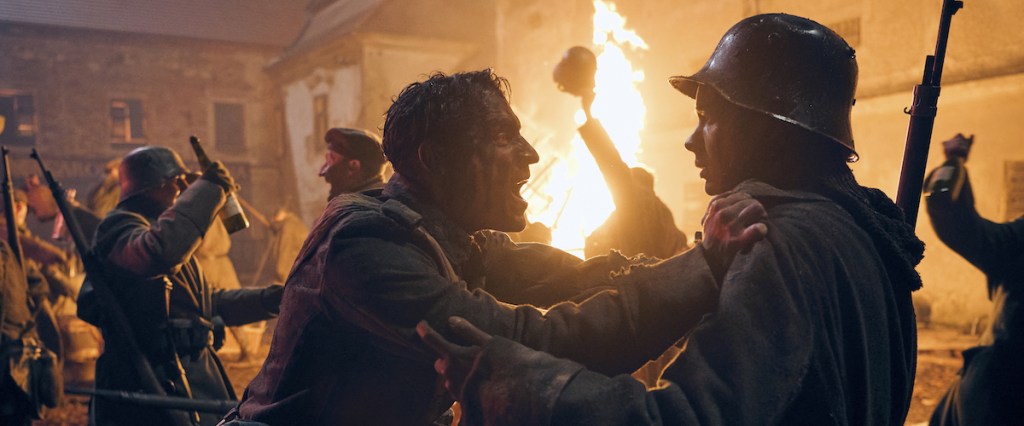
When the Armistice is eventually signed, the audience are tricked into a naïve sense of hopefulness. Maybe, our protagonist will survive, maybe he’ll be reunited with his family… However, Berger painfully crushes any dreams of success in the most brutally, realistic way possible. Seconds before the clock hits 11am, Paul is speared through the heart by a French solider. As he bleeds out, Paul stumbles through the trenches and the ceasefire finally takes place. After 2 months of continuous combat, all is finally Quiet on the Western Front. Paul dies a meaningless death for a meaningless battle. After all of that, what was the point?
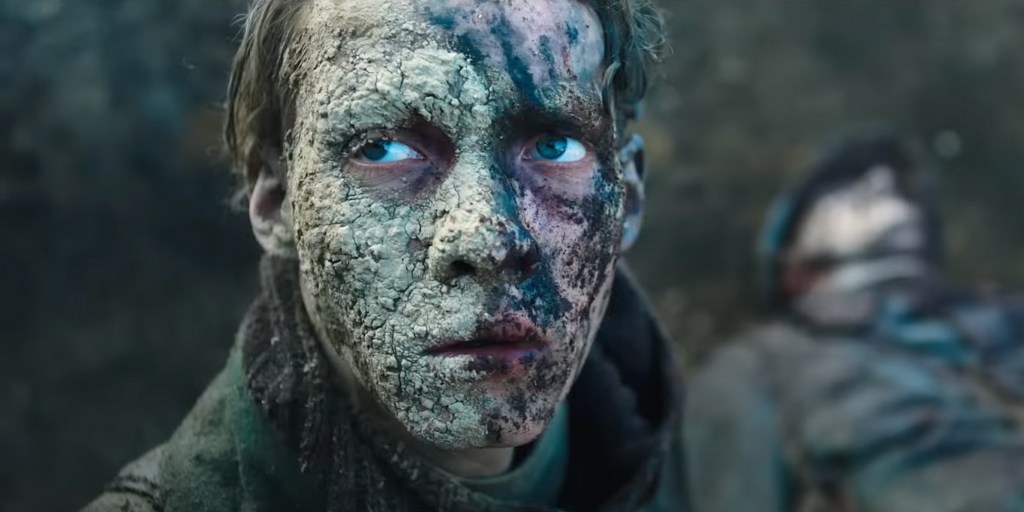
Volker Bertelmann’s haunting score rings, three echoing beats, and Berger points out to us that All is Quiet on the Western Front… only when you are dead. A true Anti-War film. Berger managed to do what Hollywood has tried to do for years. Bleak, harrowing and terrifyingly honest: a reminder of just how futile war actually is.
Lucy Speer
5th of March 2023
 There Will be Spoilers
One response to “All Quiet on the Western Front (dir. Edward Berger, 2022)”
Excellent review.
Heartbreaking 💔
LikeLike