“Prometheus stole fire from the Gods. For this he was chained to a rock and tortured for eternity.”
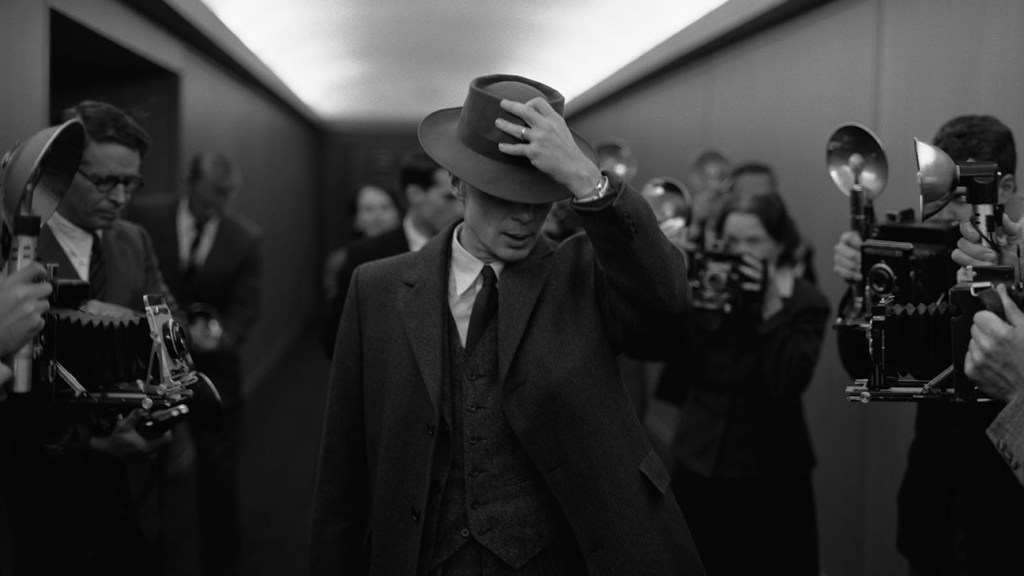
Without a doubt the most anticipated film of the year, last month saw the release of Christopher Nolan’s latest feature film, ‘Oppenheimer’. Nolan set out to radicalize cinema. By combining his metaphysical, existential cinematic style with something as intimate as a biopic, Oppenheimer is the first of its kind. Nolan ticks all his boxes: non-linear storytelling, a vibrating score and sharpened dialogue. Nolan remains rooted in his ‘Nolan-esque’, disorientating questionings of time, memory, order and perception. Not without its flaws, Oppenheimer is 3-hours of tiresome exhilaration. A story that needed to be told on the big screen.
I think it’s important to recognise that the ‘Barbenheimer’ hype (full Barbie review pending), meant that expectations for Oppenheimer were sky high. Absolutely… Oppenheimer is an excellently made, crafted piece of cinema, and I do believe it will have a revolutionary impact on filmmakers going forward. However, objectively speaking, like most films… it struggled at times.

First of all, Christopher Nolan cannot write female characters. Florence Pugh and Emily Blunt were cheated. Both of the women, who played pivotal roles in Oppenheimer’s life, had their ‘thing’, and that’s all we saw of them: Pugh, as Jean Tatlock, was more or less naked for all her scenes and Blunt, as Kitty Oppenheimer, more or less drank in all of hers. Nolan obviously hadn’t explored the complexities of their characters enough to give either Pugh or Blunt something substantial to work with. For a film that was solely occupied with the psychology of J. Robert Oppenheimer, and had less to do with the atomic bomb as to which the trailer implied, seeing the complexities and strains in his immediate relationships would have been insightful. Regardless, that was purely a writing problem. Pugh and Blunt worked phenomenally with what they were given.
In terms of flaws, the lack of character development for those other than Oppenheimer was the biggest miss. I sometimes felt Nolan’s non-linear storytelling was clunky, especially in the first Act. Jumping between Oppenheimer’s’ youth, then to the court case, then to his later conversations with Einstein and Strauss meant that it was difficult to establish a through line, and had the tendency to feel tiresome. This being said, as soon as the narrative was identified Nolan’s non-linear style had its classic, satisfying pay off at the end of the film.

Again… I think its important to stress that despite Nolan being one of the most accomplished, high-budget filmmakers working today, we shouldn’t look at his films through rose-tinted glasses because we want to love them. This being said, I’ve nit-picked Oppenheimer enough, let’s discuss what I did enjoy. And, there’s a lot of it.
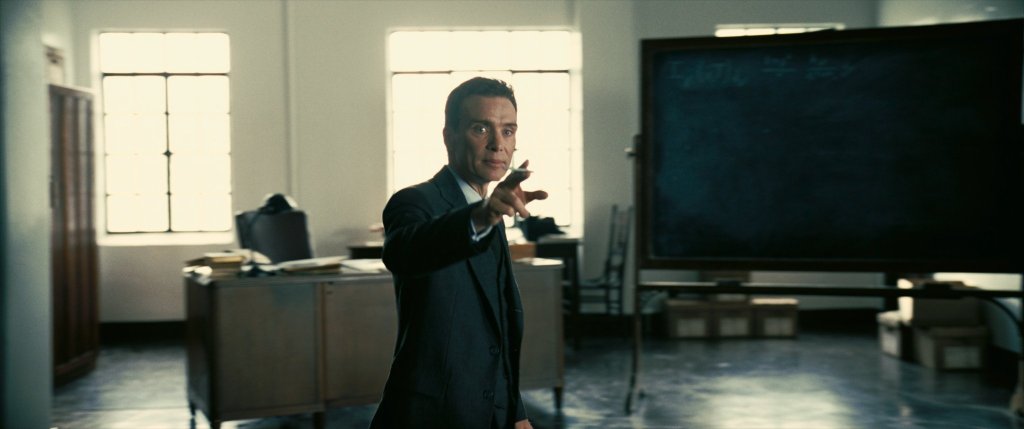
Nolan’s best decision was to root the biography of J. Robert Oppenheimer in its mythological analogy- “American Prometheus” by Kai Bird and Martin J. Sherwin. Having recently read a lot of Joseph Campbell and Jung psychology, I’m interested into how mythology and spirituality can relate to the human condition. So, to say I had a rush of excitement when the picture opened with a Prometheus quote is an understatement. The same way Prometheus suffered for bringing enlightenment to mankind, Oppenheimer was to suffer for his discoveries. The parallel between the great Prometheus and the most important scientist to have ever existed, is indicative of just how terrifying the tale is, and exposés the psychological examination we are about to observe perfectly.
Following on from this, Nolan’s true genius lies in his ability to parallel his mythological analogy in the visual cinematography. Unpacking this, presenting metaphysical, seemingly ungraspable, existential ideas… relating these mythology and mortality… then, to microcosm this into something as intimate as a psychological biopic is mind-blowing. When we recognise the film was shot on Kodak’s specially created 65mm IMAX film, yet, the majority of the film is close-up shots of Cillian Murphy (as Oppenheimer) … the thematic paradox is in parallel to the cinematography! I am astonished. If that’s not crafted cinema, then I don’t know what is.
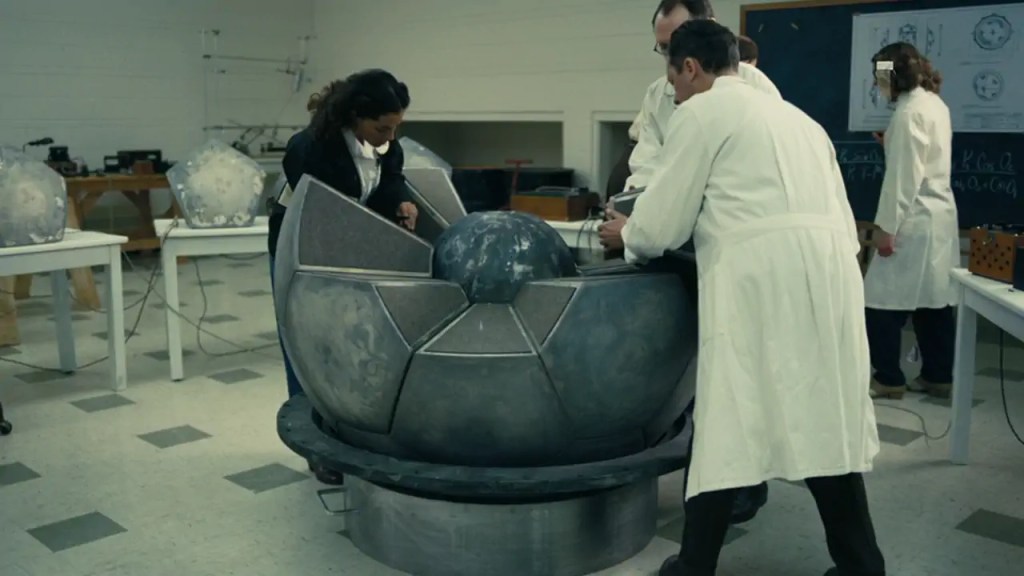
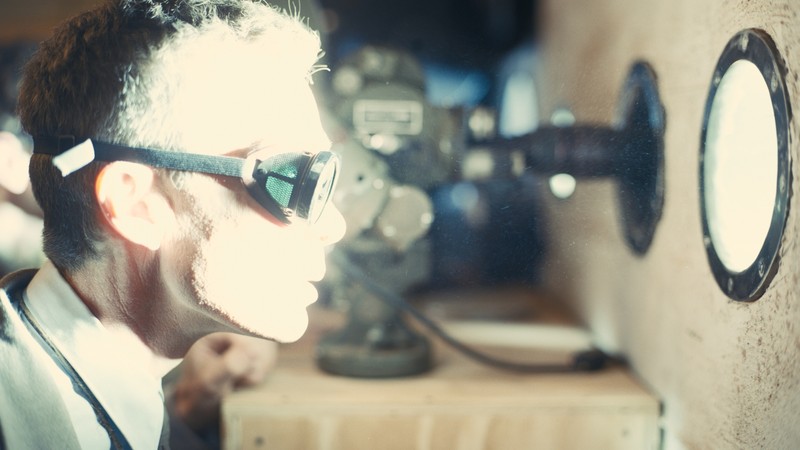
It goes without saying that Cillian Murphy gave the performance of a lifetime in the titular role- I hope he gets the recognition from the Academy he deserves. Hoyte van Hoytema’s cinematography was exquisite as usual. The cuts to abstract atomic fissions, explosives and bizarre geometrical patterns worked well in combination with Ludwig Göransson’s vibrating score, capturing the volatility of the human consciousness. After going into the film certain that actual footage of Hiroshima and Nagasaki would be shown (hence the R-rating), the uncomfortably long close-up of Oppenhiemer’s face, physically unable to look at the destruction his creation has inflicted, was more horrifying than any shown evidence could have been.

Oppenheimer is the turning point in Christopher Nolan’s filmography. Far from the spectacular, dramatist Blockbusting tales he’s told in the past… Nolan instead honed his skills, exploring psychology, the human condition, and the soul… all in relation to the Sublime.
Intimate, catastrophic, and revolutionary.
Lucy Speer
4th August 2023
 There Will be Spoilers